Why Ashtanga Repeats the Same Sequence, and Why That Helps Beginners
Doing the same poses in the same order sounds dull until you notice how much it teaches you about your own body.
October 13, 2026 · 4 min read
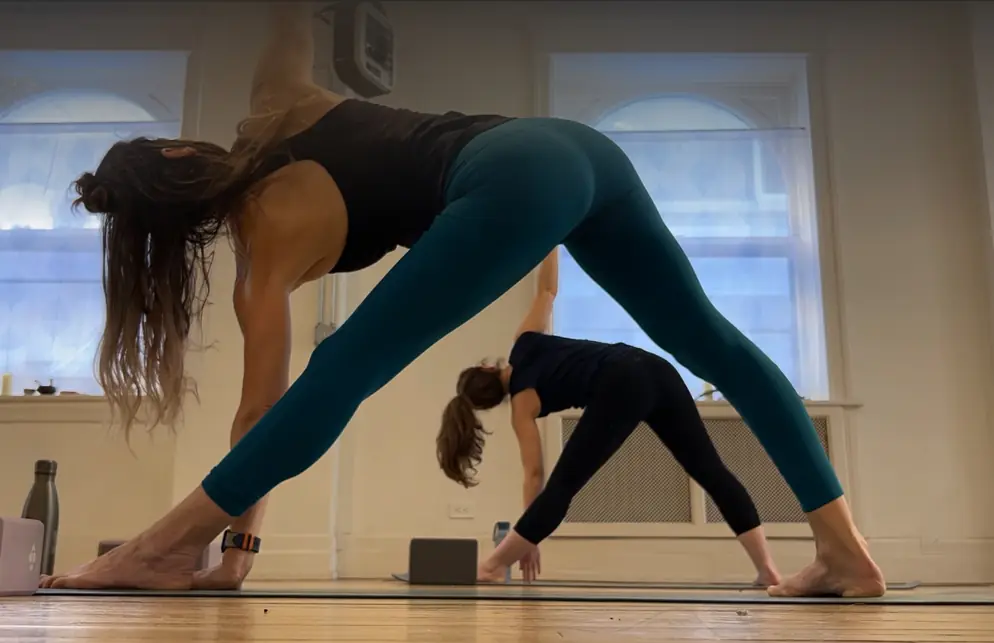
The same poses, in the same order
Most yoga classes are a surprise. You arrive, the teacher has a plan you have never seen and you follow along. Ashtanga is the opposite. The poses come in a fixed order, class after class, and the teacher guides you through the same pattern each time you show up.
That can sound dull to a newcomer, and some people skip it for exactly that reason. It is worth a second look. Fixed sequences are how many musicians learn a piece and how athletes learn a drill. You repeat the pattern until your body knows it, and then you start to notice details that were invisible the first week.
At Yoga Loft Studios, the Ashtanga classes run at 85 degrees, and they are open to all levels with beginners welcome. A Google reviewer who takes classes at the studio points out that the Ashtanga classes follow the same sequence each time, which makes them a good place for beginners to learn from repetition.
What Ashtanga Basics covers
Ashtanga Basics runs 60 to 75 minutes at 85 degrees. It teaches the traditional Half Primary Series, a shortened version of the first sequence in the Ashtanga system, with increased cueing and modifications offered along the way. In plain terms, you get the real thing with extra help.
That extra cueing matters when you are learning a sequence. The teacher names the next pose, explains how to enter it and offers an easier or more supported version if your body is not there yet. You are never expected to arrive with flexibility or strength already built.
Alongside it, Ashtanga Flow runs 60 minutes at 85 degrees. It is a Vinyasa practice inspired by the Ashtanga series, so it borrows the structure and the breath linked movement without following the traditional sequence to the letter. Many students do both and notice how each one feeds the other.
Why repetition helps when you are new
In a class that changes every time, it is hard to tell whether you are improving. A pose feels different on a Tuesday than on a Saturday, and you cannot compare two things that are not the same. In a repeated sequence, the comparison is built in. You can feel that the pose that wobbled in October holds steady in November.
Repetition also frees your attention. Once you stop wondering what comes next, you can look at your breath, your hips, the way your weight sits in your feet. The first weeks are about learning the order. After that, the sequence becomes a quiet frame in which to pay attention.
It builds strength steadily too. The same reviewer adds that it will not be easy, but that persistence and frequency make you feel yourself getting stronger. That matches how practice generally works. A little, often, in a consistent pattern, adds up faster than an occasional heroic effort.
Mysore practice and the owner's own daily routine
Mysore is the traditional, self paced way of practicing Ashtanga. Rather than following a teacher call by call, each student moves through the sequence at their own speed while the teacher circles the room and offers individual adjustments. It is named for the city in India where the system was taught.
Jill Jerome, who owns the studio and teaches there, practices Mysore and meditation daily. She has been teaching since 2009, holds Yoga Alliance E-RYT status and has additional training in the full Primary Series of Ashtanga, Power Vinyasa and Hatha. You can read her full bio on the instructors page.
You do not need to practice Mysore to benefit from Ashtanga Basics. Think of the class as a guided on ramp to the same system, one where the teacher calls the poses for you while you learn the shape of the whole.
How to read modifications without feeling behind
Modifications are not a lesser version of the pose. They are the pose, scaled to what your body can do today. A bent knee, a strap, a hand on a block or a shorter hold are all ways of taking the same shape. Using them early often means moving deeper later with fewer injuries to your pride.
When the teacher offers a modification, try it without comment. You will find that it often feels more honest than forcing the full form. Over a few weeks you may notice yourself needing less support in some poses and more in others, and that uneven progress is how most bodies learn.
Go at an honest pace, rest when you need to and remember that the point is the pattern, not the performance. If a pose is not working, tell the teacher after class. They can show you another approach next time.
Where to start and where it can lead
If you are curious, begin with Ashtanga Basics and plan to come at least three or four times before you decide. The first visit is about learning the vocabulary. By the third or fourth, the order starts to settle in, and that is when the practice begins to feel like yours.
Ashtanga is also part of the curriculum in the studio's 200-hour teacher training, so students who fall for the method have a way to go deeper. The teacher training page explains the program, and the Ashtanga class page lists the formats, temperatures and lengths.
Questions about which class to try first? Call or text (312) 560-8668 or email info@yogaloftstudios.com. The studio sits in Oak Park's Hemingway District at 115 N Oak Park Ave, and the pricing page shows the new student special of two weeks for $49.
Yoga Loft Studios, (312) 560-8668
Call (312) 560-8668More articles
Your First Hot Yoga Class in Oak Park: What 100 Degrees Feels Like
A plain guide to the heat, the pacing and the small preparations that make a first class at Yoga Loft Studios feel manageable.
How to Choose a Yoga Class by Room Temperature
At Yoga Loft Studios the temperature is the quickest way to read the schedule, from 100 degree Hatha to an unheated strength class.